Understanding Your Braces
Braces are made up of several small components that work together to gently guide your teeth into their ideal positions. Understanding each part can help you care for your braces and communicate with our team if something becomes loose or damaged.
LEARN HOW EACH PART WORKS TOGETHER
Getting to Know Your Braces
EVERY PART PLAYS AN IMPORTANT ROLE
Orthodontic braces are carefully designed to move your teeth safely and efficiently throughout treatment. Each component has a specific purpose, from holding the wire in place to applying gentle pressure that guides your teeth into better alignment.
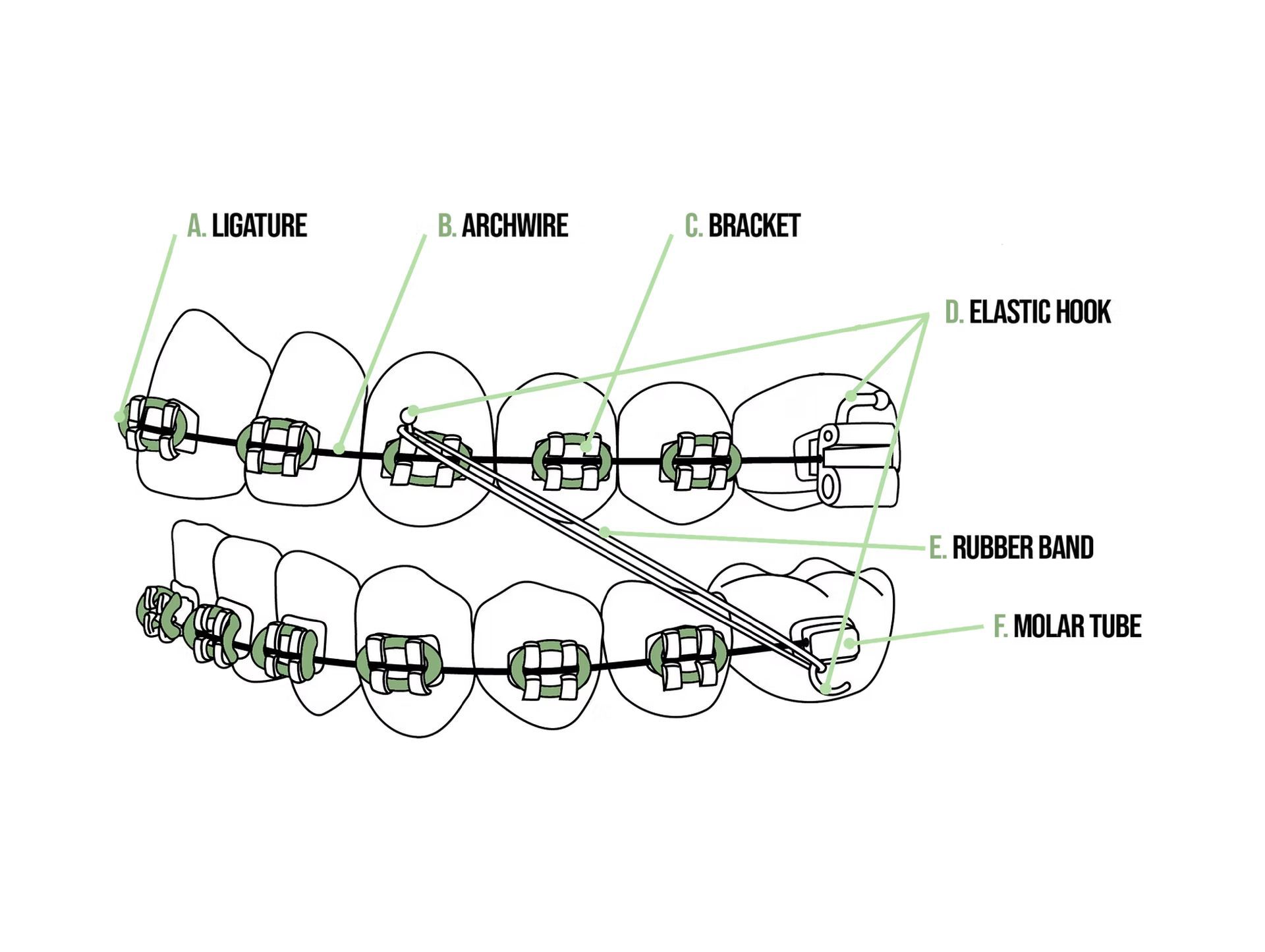
Use the labelled diagram to identify each part of your braces.
A. Ligatures
Ligatures are the small elastic donuts placed around each bracket to hold the archwire securely in place. These are the colourful bands you get to choose at your adjustment appointments and are available in a wide variety of colours. Although they are small, ligatures play an important role by keeping the archwire firmly attached to the brackets so your teeth can continue moving as planned.
B. Archwire
The archwire is the main working component of your braces, applying gentle, continuous pressure to gradually move your teeth into their planned positions. It is carefully shaped to guide your teeth into proper alignment, and Dr. Agapas may make small adjustments or add specific bends to the wire throughout treatment to achieve precise tooth movements and improve your bite.
C. Brackets
Brackets are bonded directly to the front of each tooth and serve as the anchors that hold the archwire in place. Together, the brackets and wire work to guide your teeth into alignment over time. If a bracket becomes loose or breaks, that tooth can no longer move as intended, which is why it's important to avoid foods and habits that could damage your braces.
D. Elastic Hooks
Elastic hooks are attached to certain brackets or added to the archwire when needed during treatment. These small hooks provide attachment points for rubber bands, also called elastics, which apply additional pressure to help correct your bite. Not every patient will need elastic hooks, but they play an important role when extra tooth movement is required.
E. Rubber Bands (Elastics)
Some patients are asked to wear rubber bands, also known as elastics, during their orthodontic treatment. These small bands connect to the elastic hooks and apply gentle pressure to move teeth in specific directions while improving the way your upper and lower teeth fit together. Wearing your elastics exactly as instructed is essential for achieving the best possible results and keeping your treatment progressing on schedule.
F. Molar Tubes
Molar tubes are the brackets attached to your back molars and are designed slightly differently from the brackets on your front teeth. Instead of using coloured ligatures, the archwire slides directly into the opening of the molar tube, allowing it to move your back teeth efficiently. These components provide added support and stability, helping guide the movement of your molars throughout your orthodontic treatment.